
Main innovation: the developed unified performance model enables parallel-in-time method developers to quickly assess the impact of algorithmic modifications
The parallel-in-time (PinT) community has already produced various performance models for different PinT algorithms. However, all of these models rely on an explicit implementation of the actual algorithm. These implementations are very effectively chosen, but they only reflect the potential of the implementation and not the algorithm.
In TIME-X, we have developed, for the first time, a generalized model for the performance analysis of PinT methods based on a data-driven notation of the algorithms rather than on explicit implementations. The idea is to build task graphs, direct acyclic graphs (DAGs), of the three most popular PinT methods, namely Parareal, the parallel full approximation scheme in space and time (PFASST), and multigrid-reduction-in-time (MGRIT). In such a DAG, nodes represent individual tasks and directed edges represent dependencies between nodes. DAGs are a typical and well-known method for representing parallel applications.
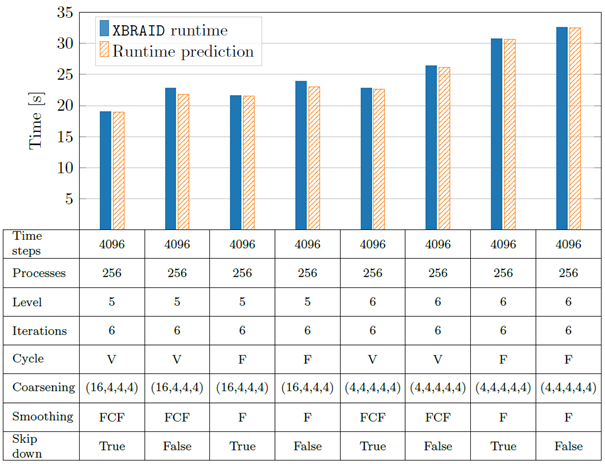
A major advantage of these task graphs is that they allow to cover the large parameter space within PinT methods, thus providing a very general model for possible variants of the algorithms. Adapting existing parallelization strategies for PinT methods as schedules of the task graph enables runtime predictions for PinT simulations for arbitrary parameter settings. For the PFASST and MGRIT method, the scheduling-based predictions were compared to the real runtimes of four established PinT libraries, and the real runtimes deviated from the predictions by at most 5% for all test cases of all libraries. The figure underneath shows the comparison between the runtime predictions (orange) and the actual measured runtimes of the XBRAID library (blue) for eight different parameter settings of the MGRIT algorithm for a model problem. The different parameters highlight the importance of the flexibility of the performance model.
Task graphs also have the advantage of being well studied and many methods for determining good schedules already exist. Therefore, the concept of task graphs can be used directly for further research into load balancing strategies for PinT methods.
Publications
- M. Bolten, S. Friedhoff, J. Hahne. Task Graph-Based Performance Analysis of Parallel-in-Time Methods.