
Partners
The TIME-X project consortium consists of 10 partners:
- Bergische Universität Wuppertal (BUW)
- Ecole des Ponts ParisTech (ENPC)
- Forschungszentrum Jülich (FZJ)
- Katholieke Universiteit Leuven (KUL)
- Sorbonne Université (SU)
- Technische Universität Darmstadt (TUD)
- Technische Universität Hamburg (TUHH)
- Technische Universität München (TUM)
- Università della Svizzera italiana (USI)
- Université de Genève (UNIGE)
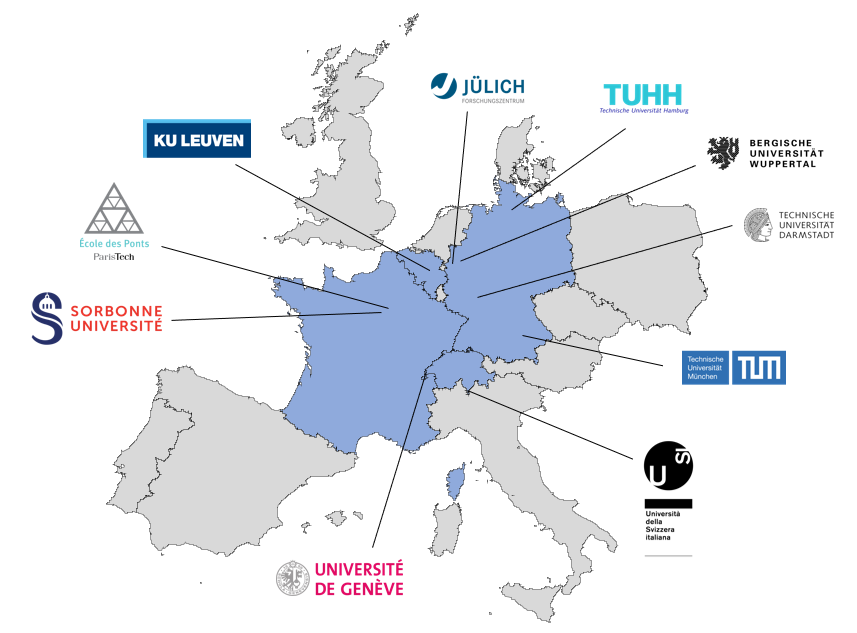
Get to know the TIME-X partners
BUW – Bergische Universität Wuppertal
Matthias Bolten & Stephanie Friedhoff
Website: https://www.uni-wuppertal.de/en/
About BUW

Bergische Universität Wuppertal (BUW) carries out international top-level research in different fields and, in addition to its broad range of teaching content, also provides a highly diverse research landscape in the individual subjects. Both basic and applied research are key components. BUW has developed a cross-disciplinary research and teaching profile based on six profile types to combine its strengths and increase public perception of its special potential and achievements. One of the strategic focus areas is “Building blocks of matter, experiment, simulation, and mathematical methods”, in which the lead for simulation and mathematical methods is within the Institute of Mathematical Modeling, Analysis and Computational Mathematics (IMACM).
IMACM combines the expertise of different mathematical groups at the BUW for solving real-life problems in industry and services, with applications in natural and social sciences, economics and engineering. It consists of 10 professors and approximately 65 doctoral and post-doctoral researchers and represents six different groups within the Department of Mathematics and Computer Science in the Faculty of Mathematics and Natural Sciences of the BUW. Research interests include operator theory, stochastic analysis, uncertainty quantification, coupled problems, numerical linear algebra, and high performance computing. Applications come from different fields in engineering, e.g., electric networks or gas turbines, finance, and the natural sciences, e.g., QCD or quantum chemistry. As the size of many of these problems requires the use of supercomputers, the development of scalable numerical methods plays an important role in many of these applications. IMACM is well-established in national and transnational research cooperations, including EU-funded research and training projects, national funding and direct funding from industrial partners. For example, in the projects ESSEX and ExaStencils within the DFG priority programme 1648 SPPEXA, extremely scalable methods for the solution of eigenvalue problems and linear systems, respectively, are being developed. In both projects IMACM researchers are responsible for the derivation and analysis of novel numerical methods with scalability in mind. Within the SFB Transregio 55 (Hadron Physics from Lattice QCD) the development of numerical methods is pursued, the size of the systems studied in this application demand for the use of large-scale high performance computers. In Horizon 2020, IMACM participates in the Human Brain Project, ITN-EJD HPC-LEAP, ITN-EID ROMSOC, ITN-ETN ConFlex, and ITN-EJD STIMULATE. As an important path to exascale, parallel-in-time methods are being studied in Wuppertal extensively, also in cooperation with the JSC in Jülich and with the Lawrence Livermore National Laboratory in California, USA. Further, BUW has been involved in the organisation of two Parallel-in-Time workshops.
Contributions to the project
BUW will engage via IMACM. Stephanie Friedhoff from BUW will lead the work on enabling extreme scale parallel computing through PinT. In addition to contributing to HPC aspects of PinT, BUW will also provide expertise on the PinT algorithms MGRIT and PFASST, on the MGRIT implementation XBraid, as well as on multigrid methods and multiscale numerical analysis techniques.
ENPC – Ecole des Ponts ParisTech
Frederic Legoll & Tony Lelièvre
Website: https://ecoledesponts.fr/en
About ENPC

The Ecole Nationale des Ponts et Chaussées (ENPC), also known as Ecole des Ponts ParisTech, was created in 1747 to train highly-specialized engineers. Among the top 3 leading French engineering Grandes Ecoles, it is also the leader of executive education via its Business School (Europe, Africa and Asia) and a second subsidiary, Ponts Formation Conseil (technical continuing education, especially in France), as well as a wide range of highly-specialized master’s programs. ENPC is part of several leading French academic consortia including ParisTech, Paris-Est and Paris School of Economics. Domain specific expertise includes sustainable development, energy transition (alternative & renewable energy), big data, applied mathematics, civil & large-scale engineering, material sciences, public policy, economics, finance, urban transport, design thinking, business and management.
In the recent years, ENPC successfully applied to several EU projects, among which the ERC Consolidator Grant MSMath (2014-2019, PI: T. Lelièvre), the ERC Starting Grant CoQuake (2018-2023 PI: I. Stefanou) and the ERC Synergy EMC2 (2020-2025, PI: E. Cancès).
Contributions to the project
ENPC will contribute to the project by its involvement in (1) PinT algorithms for simulation, optimization and uncertainty quantification, and (2) large-scale applications of PinT. ENPC has a long-term expertise of PinT algorithms. Together with G. Samaey at KU Leuven, F. Legoll and T. Lelievre at ENPC have studied multiscale problems where the fast dynamics rapidly approaches an invariant manifold. Many questions that will be addressed in Time-X stem from that seminal work, and will certainly benefit from this already established collaboration. F. Legoll has also a strong expertise in structure-preserving algorithms for Hamiltonian problems, including the design of PinT schemes within that framework.
FZJ – Forschungszentrum Jülich
Robert Speck & Hannah Rittich
Website: https://www.fz-juelich.de/en
About FZJ

Forschungszentrum Jülich (FZJ) pursues cutting-edge interdisciplinary research on pressing issues facing society today. With its competence in materials science and simulation, and its expertise in physics, nanotechnology, and information technology, as well as in the biosciences and brain research, Jülich is developing the basis for the key technologies of tomorrow. In this way, FZJ helps to solve the grand challenges facing society in the fields of energy and the environment as well as information and the brain. FZJ is also breaking new ground in the form of strategic partnerships with universities, research institutions, and industry in Germany and abroad. With more than 5,500 employees, Jülich – a member of the Helmholtz Association – is one of the largest interdisciplinary research centres in Europe.
Within the Forschungszentrum, the Jülich Supercomputing Centre (JSC) is one of the leading supercomputing centres worldwide and serves as one of 3 national centres in Germany as part of the Gauss Centre for Supercomputing (GCS). Presently, JSC has about 150 staff members and 50 third-party funded members. It provides leading-edge supercomputer resources, IT tools, methods, and know-how for researchers at FZJ and for researchers participating in more than 200 German and European projects through the John von Neumann Institute for Computing (NIC), the Gauss Centre for Supercomputing (GCS) and the Partnership for Advanced Computing in Europe (PRACE).
As a leading research institute in computational science, JSC is involved, to a large extent as founder or co-founder, in numerous national and international research collaborations including PRACE, ETP4HPC and among others three EU Horizon2020 funded Centres of Excellence (POP2, MaX, EoCoE-II). Furthermore, the JSC is leading the High Performance Analytics and Computing (HPAC) Platform subproject of the Human Brain Project, an EU flagship project that aims at developing an open research infrastructure for brain research.
Contributions to the project
FZJ will engage in the scientific work via JSC. Specifically, Robert Speck from FZJ/JSC will contribute to enabling extreme scale parallel computing through PinT. FZJ will also provide expertise on the PinT algorithm PFASST as well as on multigrid methods and their analysis. Besides HPC, FZJ also has a long-standing expertise in climate and weather research (through JSC’s Simulation Laboratories “Terrestrial Systems” and “Climate Science”) and can thus support applications in their tasks. In addition, FZJ will lead the dissemination and provides access to its vast choice of training courses on HPC, CSE and applications (which is also integrated into PRACE). Also, the HPC support teams will help project users during porting and optimisation of their codes and methods.
KUL – Katholieke Universiteit Leuven
Giovanni Samaey & Stefan Vandewalle
Website: https://www.kuleuven.be/english/kuleuven/
About KUL

KU Leuven (KUL) boasts a rich tradition of education and research that dates back six centuries. The university’s basic research orientation has always been and will remain fundamental research. At the same time, the university remains vigilantly open to contemporary cultural, economic and industrial realities, as well as to the community’s needs and expectations. KUL is currently by far the largest university in Belgium in terms of research funding and expenditure (EUR 476 million in 2018), and is a charter member of LERU. KUL conducts fundamental and applied research in all academic disciplines with a clear international orientation. In the Times Higher Education ranking KUL is ranked as the 14th European university, while in the Reuters Top 100 of the World’s most innovative institutions, KUL is listed as the first European university, for the fourth year in a row. KUL employs 7,296 researchers on its academic staff (2018). KU Leuven Research & Development (LRD) is the technology transfer office (TTO) of KUL. Since 1972 a multidisciplinary team of experts guides researchers in their interaction with industry and society, and the valorisation of their research results (124 spin offs, …).
In Horizon 2020, KUL currently has been approved more than 450 projects and is ranked fifth HES institution with regard to number of signed grants (417, worth more than 228 million euro). To date, the over 100 ERC grants involving KU Leuven researchers, (including affiliates with VIB and IMEC) confirm that KUL is a breeding ground and attractive destination for the world’s best researchers. The success in the FP7 and Horizon 2020 Marie Sklodowska Curie Actions is a manifestation of the three pillars of KUL: research, education and service to society. In Horizon 2020, we are involved in 82 Innovative Training Networks, ranking us first institution of higher education with regard to number of MSCA-ITNs. In addition, we are hosting 76 MSCA Individual Fellows.
The NUMA research unit (Department of Computer Science, Faculty of Engineering) consists of approximately 10 faculty members and 40 doctoral and postdoctoral researchers. NUMA develops and analyzes numerical algorithms and software for large-scale problems in science and engineering. This research comprises the whole range from fundamental research (including exploration of novel approximation strategies and numerical analysis) to software implementation and applications in other scientific and engineering domains. Current research topics are, among others, multiscale simulation, uncertainty quantification, optimization and control, large-scale numerical linear and multilinear algebra, highly oscillatory problems and high-dimensional integration. Algorithm design for specific applications is always done in collaboration with domain experts. Current applications include nuclear fusion, metallic and polymeric material science, bio-engineering, acoustics, mechatronics and computational finance.
Contributions to the project
Via NUMA, KUL’s research contributions to the project predominantly lie on the use of multiscale models in PinT methods and on some aspects of uncertainty quantification. Giovanni Samaey of KUL will act as the official Coordinator of the project and take up all associated responsibilities concerning progress monitoring, reporting, and communication with the EU. As such, the consortium will be able to exploit the ample expertise, as well as the already present administrative staff, of both KUL as a whole and the Department of Computer Science in particular.
SU – Sorbonne Université
Laura Grigori, Caroline Japhet, Yvon Maday, Olga Mula, Pascal Omnes, Julien Salomon & Gabriel Turinici
Website: https://www.sorbonne-universite.fr/en
About SU

Sorbonne Université (SU) is a fully multidisciplinary research-intensive university, in campuses at the heart of Paris. SU covers all major disciplinary fields and offers transversal academic and research programs with three faculties: Humanities and Social Sciences, Medicine and Sciences & Engineering. With more than 4700 doctoral students and 6400 researchers, SU is one of the leading French universities.
The university is involved in numerous European and International partnership agreements and has France’s largest scientific library and infrastructures bringing together the best talent in a wide array of these disciplines. In addition to Nobel Prizes, Fields Medals and other awards, the university has exceptional transdisciplinary institutes and is also the headquarters for the European Marine Biological Research Centre. The Shanghai 2019 University list ranks Sorbonne Université 11th in Europe, 44th in the world and 2nd in the world for Mathematics. Its longstanding tradition of quality is witnessed by the fact that 17 Nobel laureates have studied at the Faculties of Science and of Medicine in Paris, from which SU is the main heir. Mathematics is at the core of its excellence: 6 Fields medalists studied or worked at SU or the Paris Faculty of Sciences.
The Laboratoire Jacques-Louis Lions created in 1969 is an applied mathematics laboratory of SU and has acquired an outstanding reputation for its contributions in mathematical and numerical analysis. The laboratory hosts many internationally recognized scientific personalities. The Research and Innovation office, which is in charge of the EU projects at the university, has managed so far 150 FP7 and more than 140 H2020 projects (45 ERC grants, 40 MSCA grants, and 45 industry-sponsored research chairs). The office will manage all the financial, administrative and legal aspects for the participation of SU in this project.
Contributions to the project
The personnel involved has already a long list of contributions in the domain of this project and an expertise since at least the early 2000’s when Maday, Turinici and Lions proposed the parareal in time method. This approach that was conceived as a generalization of the (spatial) domain decomposition method and has been since then compared with other former approaches. It allowed to shake the ideas and open a new direction for the parallel resolution of time dependent problems. After a large number of contributions pushing this idea forward, the approach, together with complementary approaches that have been developed in other groups, we intend to work on the adaption of the current results to real life problems posed in the frame of this project driven by real applications requirements. Our contributions are meant to deal with these adaption, and required modification of the schemes to adapt the full size of the problem together with the development of new algorithms to answer new questions, in particular for tackling Hamiltonian problems and stochastic PDEs where the goal is not the same as for classical evolution PDEs. The actual implementation of the methods together with the optimization in all respects will also be the subject of our contributions.
TUD – Technische Universität Darmstadt
Sebastian Schöps & Iryna Kulchytska-Ruchka
Website: https://www.tu-darmstadt.de/index.en.jsp
About TUD

Since its foundation in 1877, TU Darmstadt (TUD) has been characterized by a special pioneering spirit. It is part of its self-image to continuously continue this tradition of innovation. Through outstanding achievements in research, teaching and transfer, the university opens up important scientific fields of the future and new opportunities for shaping society. This makes TU Darmstadt one of the leading technical universities in Germany with high international visibility and reputation. The university has ca 5000 employees and awards ca 500 PhDs per year.
Particularly relevant for this project is the Center of Computational Engineering (CCE) at TUD which gathers research and teaching in CE since 2001. CE is a fast-evolving research field addressing the modelling, simulation and optimization of engineering problems. CE provides a virtual laboratory for the research and development (R&D) of products, processes and services. CE accelerates the introduction of new design concepts, working principles, materials and manufacturing techniques. The impact of CE on progress in science and technology is beyond dispute.
One of the contemporary challenges in CE is the representation of computational models and their accompanying simulation techniques in a sufficiently holistic way, i.e., making sure that modelling, simulation and optimization keep pace with the ever-increasing complexity of future R&D tasks. Research and teaching at CCE is carried out by a consortium of mathematicians, computer scientists, electrical and mechanical engineers and material scientists. It is organized orthogonally and in addition to existing departments covering the application disciplines in science and engineering.
Contributions to the project
TUD is coordinating the large-scale applications of PinT to electromagnetism and is contributing to several methodological tasks, in particular to optimization and optimal control, uncertainty quantification and data assimilation, multiscale propagators.
TUHH – Technische Universität Hamburg
Daniel Ruprecht
Website: https://www.tuhh.de/tuhh/en/
About TUHH

Having been founded in 1978, TUHH is one of Germany’s youngest Technical Universities. TUHH is following a path of combining internationally recognised, interdisciplinary research with strong collaborations with industry and other stakeholders. It is consistently ranked highly in international rankings with respect to industrial engagement and about half of TUHH’s research funding comes from third parties. TUHH has research cooperations with large companies like Airbus but also holds numerous cooperation agreements with SMEs. TuTech Innovation GmbH supports applied research at TUHH by providing comprehensive professional research management services including support in dealing with issues around intellectual property (IP).
Following a comprehensive “growth plan” (Wachstumsplan), TUHH will expand substantially in the near future. Its budget is set to increase by 25% over the next five years, funding an increase in the number of full professors from 92 to 117 and around 1000 additional places for students.
TUHH is a member of the European Consortium of Innovative Universities (ECIU), a network of research-intensive universities, that emphasises innovation, creativity and societal impact. Founded in 1996, ECIU is now intensifying the collaboration as one of the first 17 consortia to be awarded Erasmus+ funding to a European university alliance.
Contributions to the project
Through DR, TUHH will contribute to the development of extreme-scale PinT solvers and their application in large-scale simulations in Electromagnetics and Weather and Climate. DR has extensive experience in the development of efficient numerical algorithms, their implementation for HPC systems and their application in engineering or the physical sciences. He has developed numerical methods for models in atmospheric science, geophysics, fusion reactors, robotic manipulation and combustion engines.
TUM – Technische Universität München
Martin Schulz, Martin Schreiber, Hans-Joachim Bungartz & Tobias Neckel
Website: https://www.tum.de/en/
About TUM

The Technical University of Munich (TUM) is characterized by a unique profile with its core domains natural sciences, engineering, life sciences and medicine. The institutional strategy is focused on strengthening the excellence of disciplinary core competences in research, teaching and learning, but is also targeted towards the promotion of ground-breaking, interdisciplinary research. TUM is committed toward the major challenges facing society in the 21st century in areas such as energy, climate, and environment, natural resources, health and nutrition, communication and information, mobility and infrastructure. Besides research and teaching, TUM inspires and pro-actively empowers its students, academics, and alumni to think and act entrepreneurially. It initiates growth-oriented start-ups and assists its entrepreneurs in building new companies (TUMentrepreneurship).
Looking at the contributions published in the particularly renowned academic journals of the “Nature” Group and the “Science” Group, TUM is positioning itself as number 42 and 1st in Germany. THE World University Ranking has rated the Technical University of Munich (TUM) as one of the four best technical universities in Europe. TUM placed second in comparison to all other universities in Germany and was ranked number 43 worldwide. And according to the ranking published by the news agency Reuters, TUM has been ranked 7th among Europe’s most innovative universities.
TUM is member of the EuroTech Universities Alliance which was founded in 2006 and brings together six top-class universities (DTU, TU/e, EPFL, L´X, The Technion and TUM). Together they are committed to finding technical solutions which address the major challenges of modern society. Their intensive collaboration across research, education & innovation support the EU´s goal of smart, sustainable and inclusive growth.
Contributions to the project
TUM will take the leadership on the realization of adaptive PinT. From the application side, Martin Schreiber (TUM) will lead improving existing parallel-in-time methods for weather and climate simulations targeting the model of the European Center of Medium-Range Weather Forecasts (ECMWF).
USI – Università della Svizzera italiana
Rolf Krause, Maria Nestola & Alena Kopanicakova
Website: https://www.usi.ch/en
About USI

Università della Svizzera italiana (USI) is a young university established in 1996. It is organised in five faculties: Communication Sciences, Economics, Informatics, Architecture and Biomedical Sciences. The University is actively involved – with a strong multi-disciplinary approach – in many competitive research projects, funded at both national and European level (Swiss National Science Foundation, EU Framework Programmes, Innosuisse – the Swiss Innovation Agency, private foundations, …). Among others, USI is currently involved in several Horizon 2020 collaborative and individual projects. In particular, to this day, 20 ERC Grants have been awarded to USI researchers.
The ICS (Institute of Computational Science, (founding) director R. Krause) has been created in 2008 as a strategic measure of USI to foster computational sciences at USI. During the last 10 years, ICS has grown into an institute with 12 working groups and more than 60 people, hosting 5 ERC grants. ICS is furthermore the only interfaculty-institute at USI spanning three faculties, i.e. Informatics, Biomedical Sciences, and Economics. It is therefore an ideal place for the targeted scientific and application oriented work. ICS is collaborating tightly in various projects with the Swiss Supercomputing Center CSCS, which is also in Lugano.
ICS host furthermore CCMC, the Center for Computational Medicine in Cardiology, https://www.ccmc.usi.ch. CCMC has been created in order to provide an interdisciplinary environment for the development and use of new computational approaches related to cardiac pathophysiology. CCMC hosts expertise in life sciences, medicine, natural science, applied mathematics, and computational science to develop computational technologies and translate them into the clinic.
Contributions to the project
The group of Prof. Krause is working for a decade now on space-time methods and will contribute with algorithmic knowledge and knowledge in the numerical analysis of space-time methods. Moreover, in the group a broad software basis has been developed, which will be used within TIME-X.
UNIGE – University of Geneva
Martin Gander
Website: https://www.unige.ch/en/
About UNIGE

With its foundation by John Calvin in 1559, the University of Geneva (UNIGE) is one of the oldest universities in continental Europe. With about 10,000 students, it is a small university, but its Faculty of Sciences ranks regularly in the top 30 worldwide, and with the recent Nobel Prize for Michel Mayor and Didier Queloz for the discovery of the first exo-planet, and the recent Fields Medals for Stanislav Smirnov, professor of Mathematics at UNIGE, and Martin Hairer four years later, son of a professor in numerical analysis at the UNIGE, it stands at the top with the very best for research in the sciences, second only to ETHZ, the top Federal Institute, in Switzerland.
Contributions to the project
The numerical analysis group led by Martin J. Gander provides the theoretical backbone for this project and the development of PinT algorithms. It will host visits for all the other partners to discuss and solve technical problems in the large variety of PinT algorithms to be developed throughout the project entire duration and all mathematical tasks, and also develop two brand new PinT algorithms for PDE constrained optimization and optimal control. Also the multiscale propagators will receive special attention due to the multiscale expertise available in the group.