
Main innovation: the recovery strategies lead to robust & adaptive PinT algorithms that can cope with various sources of inexactness
The ability of an algorithm to tolerate and recover from a certain amount of inexactness (e.g., hard- and software errors) is crucial in the context of exascale computing. Here, we have focused on coping with soft faults, which are transient unexpected occurrences during the computation, which can manifest as bit flips in the solution. For these, we have implemented time-adaptive spectral deferred correction (SDC) methods within the pySDC framework, which prove to be naturally resilient against such faults. SDC iteratively solves fully-implicit Runge-Kutta (RK) methods and is particularly well suited for stiff problems. Existing convergence theory from embedded RK methods can readily be transferred to enable adaptive time-stepping. This is based on controlling the local error by adjusting the step size in conjunction with possible restarts from the initial conditions of the step.
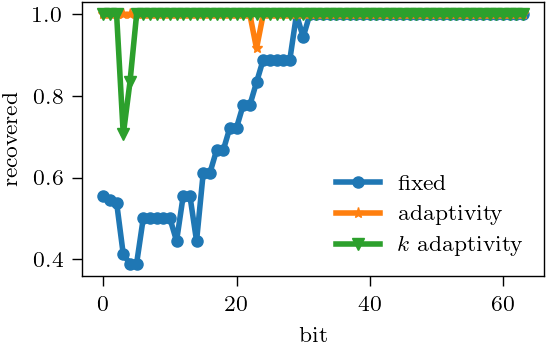
The below plot shows the recovery rate based on the global error relative to the fault-free case from random bit flips to a van der Pol oscillator problem with three different modes of running SDC. The “fixed” mode keeps the iteration number and step size fixed, whereas “adaptivity” employs our step size controller with fixed iteration number, and “k adaptivity” iterates until a residual tolerance is reached, but using a fixed step size. While both kinds of adaptivity boost resilience and efficiency at the same time, controlling the step size allows much more finely grained adjustments of the temporal resolution than controlling the iteration number, meaning more computational efficiency can be leveraged.
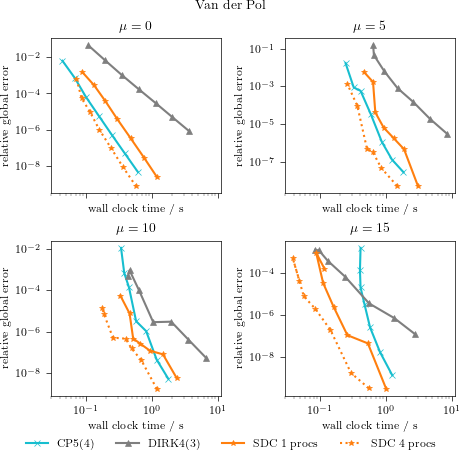
While replication has been shown to provide resilience at the cost of significant overhead, we aim to develop similarly robust, but more computationally efficient algorithms. First steps have been taken to extend the adaptive step size controller to small-scale time-parallel methods. The TIME-X publication “A unified analysis framework for iterative parallel-in-time algorithms” has shown that the properties required to use adaptivity in SDC are carried over to the parallel-in-time algorithm Block Gauss-Seidel SDC. The plot below shows that while explicit embedded Runge-Kutta schemes, such as Cash-Karp’s method, can be more efficient than serial adaptive SDC of the same order for non-stiff problems, parallel-in-time Block Gauss-Seidel SDC can beat it. For more stiff problems, the implicit serial SDC can already be more efficient than both implicit and explicit embedded Runge-Kutta pairs, but the speedup from time-parallization carries over to make it even better.
Discussions with international partners (University of Tennessee at Knoxville, Clemson University) on further exploitation of this work are ongoing. These include mitigation of hard faults, which crucially relies on dynamic resource management, as well as leveraging the iterative nature of SDC by employing compression techniques.