
Main innovation: Generalization of Parareal to differential algebraic equations (DAEs), enabling large-scale HPC time parallelization of such problems (for instance, large electrical circuits or power networks).
Many realistic simulation problems cannot be described by (large sets of) ordinary differential equations (ODE) alone, they also need additional algebraic relations, wich leads to Differential Algebraic Equations (DAEs). These DAEs come with additional challenges, such as the determination of initial values: for ODEs, initial values can be freely chosen, but for DAEs, they must fulfill the algebraic constraints. This is particularly complicated since the solution may be subject to hidden algebraic equations that are implicitly contained in the DAE system but not explicitly accessible. They can emerge when differentiating the algebraic equations with respect to time.
A very well-known toy example for a DAE with (hidden) constraints is the mechanical pendulum expressed in Cartesian coordinates. However, here we are interested in the simulation of large electric circuits with millions of devices that are expressed in terms of the modified nodal analysis which leads to a complex system of DAEs. Modern circuit simulators (e.g., Xyce) are already expertly parallelized on the level of matrix assembly and solving the equations per time step, but they are not yet parallel in time. One reason is that most (blackbox) parallel-in-time methods are based on the idea of modifying initial values which is cumbersome for DAEs.
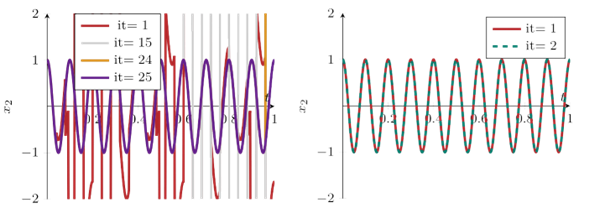
Here, we propose a very simple micro/macro-Parareal method to deal with such differential-algebraic equations with hidden constraints. This is a break-through result because it enables large-scale HPC time-parallelization of circuit simulators or any other tool that is based on DAEs. The following picture shows a demonstration:
Publication
- Garcia, I.C., Kulchytska-Ruchka, I. & Schöps, S. Parareal for index two differential algebraic equations. Numer Algor 91, 389–412 (2022).